

In the report ‘Speed as a key success factor for scale-ups. The Dutch scale-up ecosystem in an international perspective' , the researchers compare the Dutch ecosystem with those of, amongst others, the United States, China and Singapore. They also spoke to entrepreneurs from LeydenJar, VitalFluid and SandGrain about the obstacles they encounter in practice.
Lagging behind Europe and the US
The figures show that the Netherlands has some ground to make up in terms of continued growth:
Of Dutch start-ups, 21.6 per cent grow into scale-ups. In Europe, that figure stands at 24.1 per cent, and in the US at 52.2 per cent.
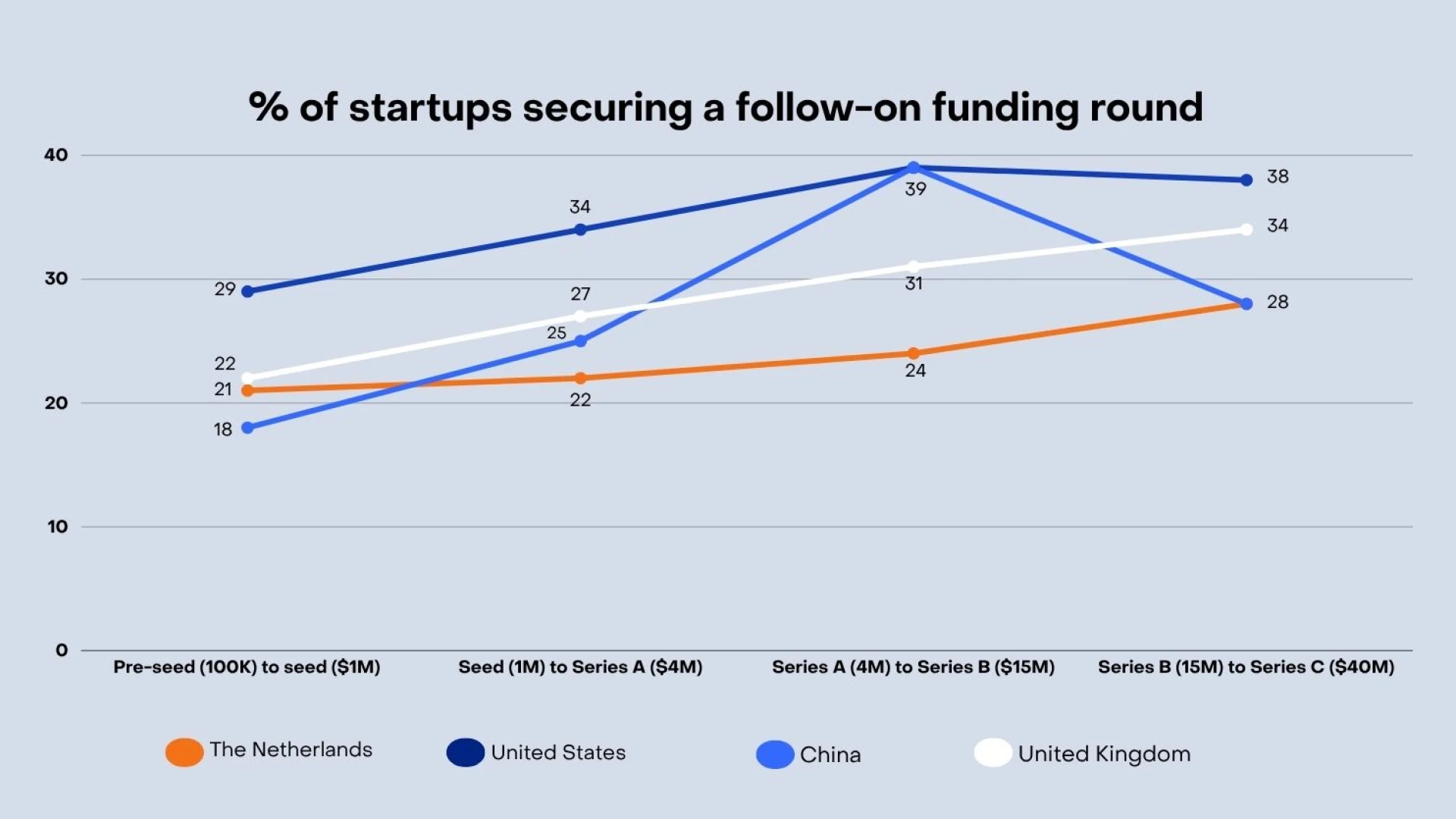
The difference is particularly marked when it comes to follow-on funding. In the US, 39 per cent of companies secure a Series B round after a Series A round; in the Netherlands, the figure is 24 per cent.
The speed at which this happens also differs: European companies take an average of 5.8 years to make that step, whilst American companies take 2.3 years.
As speed is often a decisive factor in international competition, the Netherlands is consequently missing out on economic activity, value and strategic technology.
Lessons from abroad, but not a carbon copy
China and Singapore demonstrate that targeted government policy can accelerate growth. China invests heavily in strategic technologies and has a large domestic market, whilst Singapore focuses primarily on training and attracting talent. The researchers do, however, warn that the Netherlands and Europe differ too much from China and the US in terms of governance and scale to simply adopt their approach. Europe will have to find its own path.
Interrelated challenges
At the same time, growing tech companies need growth capital, technical talent, test sites and production space, licences and capacity on the electricity grid. If one or more of these prerequisites is missing, scaling up will be delayed or even come to a complete standstill. There is also a challenge within the companies themselves: many tech firms excel at technology development, but during the growth phase they need to build new capabilities in the areas of production, sales, leadership and market development.
The companies interviewed recognise this picture:
LeydenJar (battery technology) faced a delay of around a year because the electricity connection for a new factory had not been provided. Long-running subsidy processes also hampered growth.
VitalFluid (plasma-activated water for horticulture) faces particular challenges due to European regulations that are ill-suited to this type of innovation, making market access time-consuming and costly.
SandGrain (cybersecurity) identifies the transition from technology development to market launch as a critical phase, during which a company must simultaneously acquire customers, build up turnover and convince investors.
Coherence as the key
According to the researchers, there is no simple solution. Additional growth capital only really pays off if companies also have access to talent, facilities, energy, appropriate regulations and a market. European cooperation is essential in this regard, as the Dutch market is too small on its own. At the same time, the Netherlands can already do a great deal itself, for example:
make more growth capital available to companies in later stages of funding;
invest in technical talent and leadership;
improve access to testing facilities, production space and energy infrastructure;
ensuring simple and predictable regulations;
the government acting more frequently as a ‘launching customer’ for innovations.
NXTGEN Hightech also points out that the new European Innovation Act offers an opportunity to accelerate further growth, provided that the European agenda is translated into a decisive national approach.
Lotte de Groen, Market Director at TNO Vector, argues that the Netherlands possesses excellent expertise and many innovative entrepreneurs, but that start-ups are currently wasting too much time. By tackling these bottlenecks in a coordinated manner, she believes more Dutch innovations can grow into internationally successful companies. Monika Hoekstra, Managing Director of NXTGEN Hightech, emphasises that entrepreneurs do not need to build up all the knowledge and experience themselves. She believes that collaboration with companies, knowledge institutions and specialised Dutch suppliers offers many opportunities to scale up more quickly and secure a strong position in the global market.