

CENACO
How does it work?
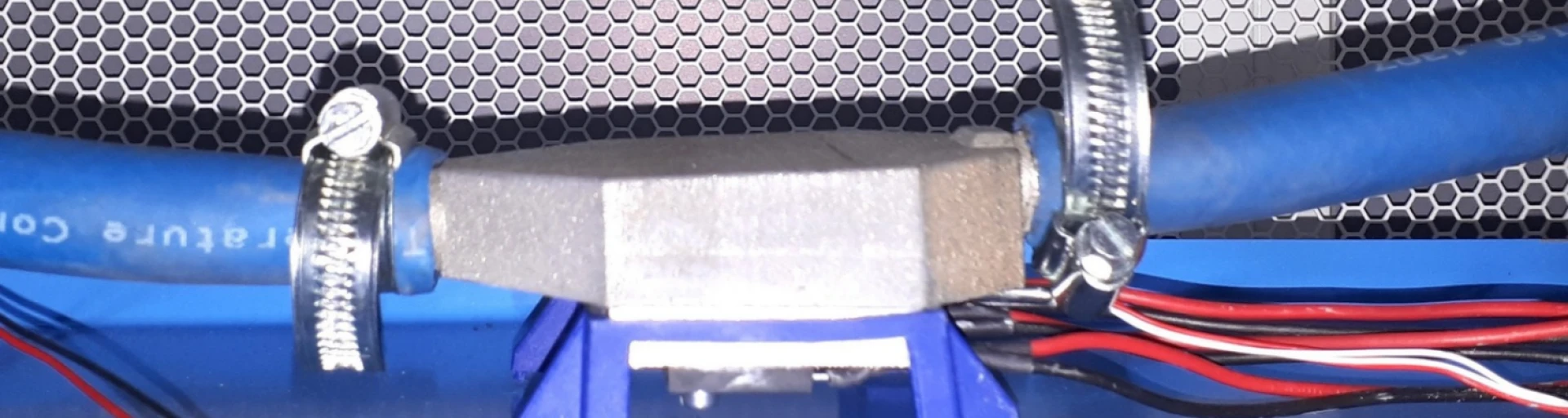
In the test setup, a 3D-printed heat sink absorbs heat from the electronic component to be cooled and transfers it to a circulating liquid. The same liquid then releases the heat to the outside air via a heat exchanger positioned at a higher level. The driving force behind this liquid circuit is the difference in liquid density between the cold and the warm side of the circuit.
Why this one-year research project?
3D printing technologies such as Molten Metal Deposition (MMD) and Powder Bed Fusion (PBF), combined with simulation software, make it possible to design and test heat sink prototypes quickly. The design freedom offered by 3D printing allows for the search for an efficient geometry, so that the design can remain relatively compact. This cooling method has several advantages. No external energy is needed for the cooling circuit, as no pumps or fans are used, which makes the system energy-efficient. The system produces hardly any noise or vibration and has no moving parts, so there is virtually no wear. No electromagnetic fields are generated, so there is no interference with surrounding equipment. The system is also reliable, as it is very unlikely to fail. Finally, no investment in fans and air handling equipment is required, which also reduces the use of raw materials. In addition to determining an efficient geometry and the potential cooling capacity, we aim to investigate how a system with multiple heat sources behaves. To this end, ten sources are connected in parallel, one above the other, to the same circuit in the test setup.
Results
The first results, based on cooling an Intel Xeon Platinum processor, are shown in the graph below. The graph shows the critical temperature as a function of power at different water temperatures.