

The policy agenda follows on from the MedTech Growth Plan, which the sector presented at the end of 2025, and from the Wennink Report on the Netherlands’ future earning capacity. The public-private investment was announced during a working conference organised by the government’s Task Force on Future Prosperity and the Business Climate (TTWV). The aim is to work together with the sector towards a single MedTech ecosystem, supported by start-ups, SMEs, knowledge institutions, technical universities, healthcare organisations and large enterprises.
Government presents MedTech 2035 policy agenda: the Netherlands aims to have the strongest MedTech ecosystem in Europe
26 October 2026
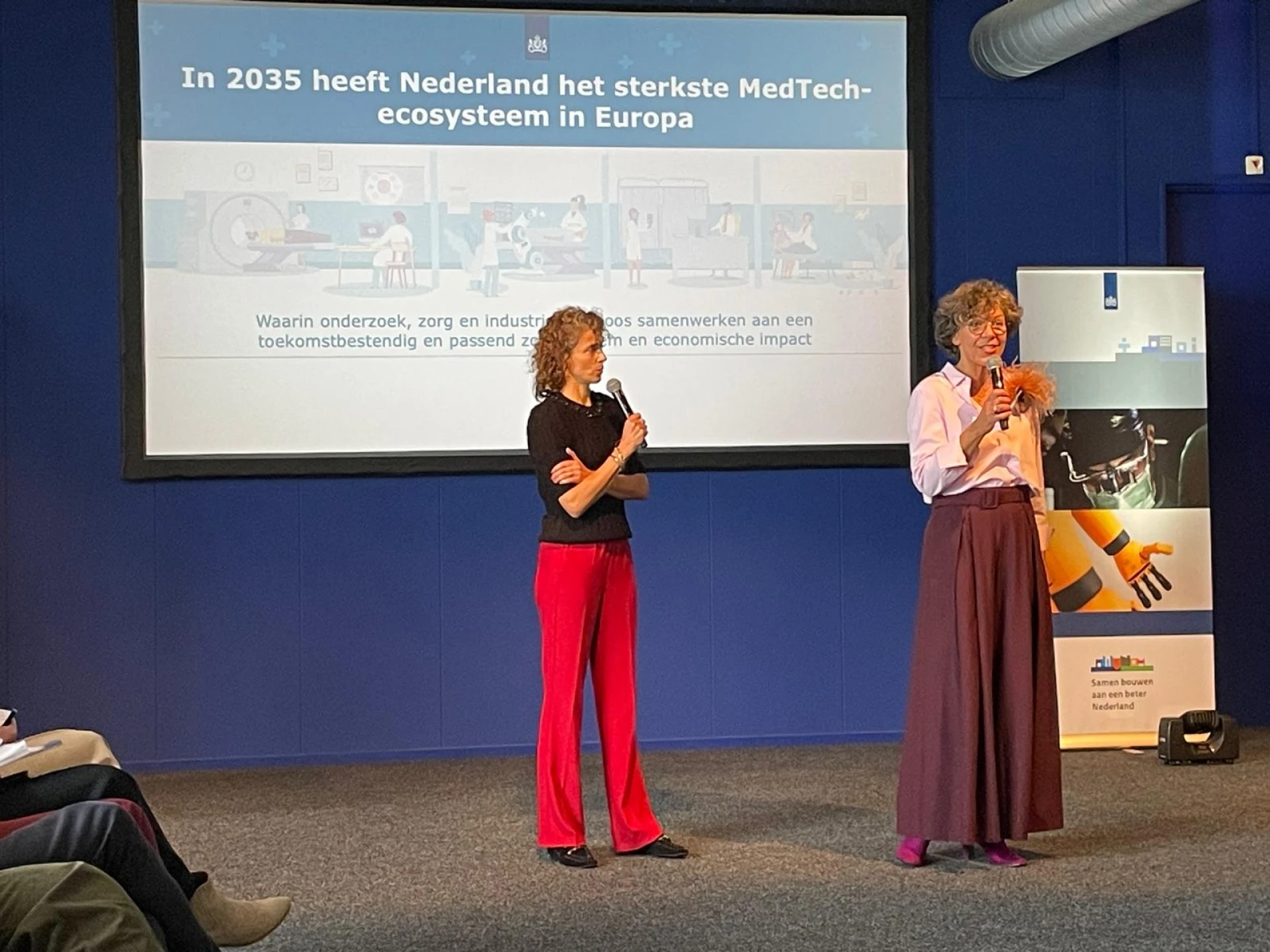
By 2035, the Netherlands will have the strongest MedTech ecosystem in Europe, in which research, healthcare and industry work together seamlessly to create a future-proof and appropriate healthcare system, whilst also generating economic impact. This ambition is central to the MedTech 2035 policy agenda, which Ministers Heleen Herbert (Economic Affairs and Climate Policy, EZK) and Sophie Hermans (Public Health, Welfare and Sport, VWS) have today submitted to the House of Representatives. The government is investing €102.5 million up to and including 2036. Invest-NL and institutional investors today announced a further €150 million in private funding, on top of the €50 million already committed by Philips in July.
Better healthcare and a stronger economy
Minister Heleen Herbert (EZK):
“Further improving healthcare is perhaps our most important social challenge. Technological innovation can make a major contribution to this and also strengthens our own economy. The MedTech sector in the Netherlands is, in fact, a promising growth market. Moreover, medical technology provides solutions to keep our healthcare system afloat. Think, for example, of tackling staff shortages and the growing demand for care due to an ageing population. That is why we are going to work together more effectively, enabling us to take major steps – through public-private partnerships – to realise this ambition.”
Minister Sophie Hermans (VWS):
“Medical technology is indispensable for healthcare providers and patients. It offers solutions that help to detect, treat and sometimes even cure diseases. Furthermore, technological innovation is essential to keeping our healthcare system future-proof and resilient. With smart solutions – such as the use of AI or robotics – we can provide more care with the same number of healthcare professionals. Or ensure that healthcare professionals have more time to devote to their patients. The investments we are making now will help ensure that innovations are more effectively integrated into the Dutch healthcare system.”
Leo Warmerdam, Managing Director of Holland High Tech:
“This policy agenda gives the MedTech sector exactly what it needs: a single shared ambition, national coordination and the resources to take decisive action. The Netherlands’ strength lies in the synergy between world-class healthcare institutions, knowledge institutions and a high-tech manufacturing industry that supplies key technologies, ranging from imaging and photonics to chips and robotics. Holland High Tech positions this high-tech sector – from research institutions to large corporations and SMEs – to contribute to the MedTech of the future. In this way, we are working together to improve healthcare, increase job satisfaction for healthcare professionals and boost the Netherlands’ earning potential.”
Why MedTech matters: for the healthcare sector and as a growth market for the Netherlands
Medical technology (MedTech) is indispensable in the healthcare sector and one of the most important growth markets for the Dutch high-tech industry. The sector accounts for €13.5 billion in production turnover and €6.4 billion in gross value added (2025), some 32,700 direct jobs and a top-five position in global MedTech patents. By 2035, the sector could generate a further €5 billion in additional export value per year and create around 11,000 new jobs.
At the same time, MedTech is helping to improve healthcare and ease the pressure on healthcare staff. The Netherlands is heading for a shortfall of 227,000 healthcare workers by 2035, whilst demand for care continues to grow due to the double ageing of the population. Innovations involving artificial intelligence (AI) and robotics offer opportunities to prevent the need for care, organise care closer to home and give care providers more time for their patients.
These opportunities are significant, but they cannot be taken for granted. The global MedTech market is growing by around 5 per cent a year, but the Netherlands’ competitiveness is under pressure: promising start-ups are leaving, dependence on manufacturers outside the EU is increasing, and proven innovations are not always scaled up. That is why the Government now wants to translate the Netherlands’ strong position in MedTech into broad social and economic value: a future-proof healthcare system, greater resilience and increased earning potential.
Two flagship initiatives and six priority tasks
The Government is, first and foremost, investing in two flagship initiatives: public-private projects that help address the challenges facing the healthcare sector, deliver added value for patients and strengthen revenue-generating capacity. Public funding will be matched by private contributions, with a target of 70 per cent private matching.
A new generation of image-guided therapies using AI and robotics. The Netherlands occupies a unique position in this field, spanning science, the high-tech manufacturing industry and healthcare. From 2027, the Ministry of Health, Welfare and Sport (VWS) and the Ministry of Economic Affairs and Climate Policy (EZK) will fund three two-year projects in the fields of cardiovascular disease, oncology and stroke, with broad involvement from companies, research institutions and hospitals. The aim: to make the Netherlands a global leader, with opportunities for start-ups, scale-ups and related industries.
Technology for tomorrow’s healthcare. A two-year initial investment in the regional ‘Hospital of the Future’ initiative in Twente. This is creating an integrated value chain in which proven innovations are implemented and scaled up at an accelerated pace, so that they spread like wildfire to other regions. The ambition: a 4% improvement in healthcare productivity by 2035, equivalent to 56,000 FTEs of healthcare capacity.
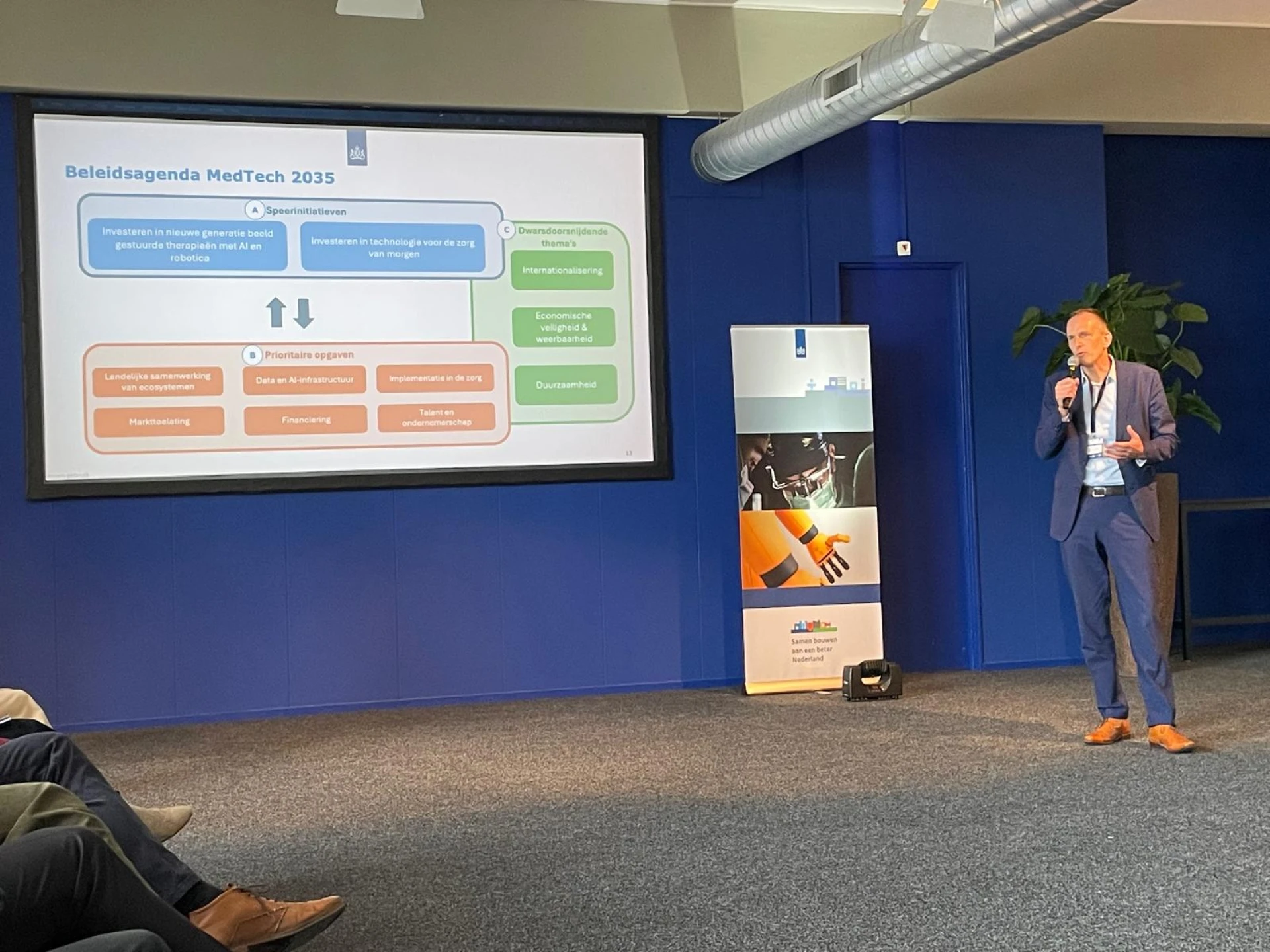
In addition, the Government is taking the lead at national level on six priority tasks: the enabling conditions for innovation, production, implementation and upscaling in the Netherlands:
National collaboration between ecosystems
Data and AI infrastructure
Implementation in the healthcare sector
Market authorisation
Funding
Talent and entrepreneurship.
Specific actions include mapping the Dutch MedTech innovation ecosystem, establishing a single national healthcare data infrastructure by 2029, exploring regulatory sandboxes for market authorisation, setting up a venture capital roundtable organised by Invest-NL, and implementing a targeted talent strategy. Internationalisation, economic security and resilience, and sustainability run as cross-cutting themes through all activities.
The implementation will be organised through a national partnership structure overseen by the Ministry of Economic Affairs and Climate Policy (EZK) and the Ministry of Health, Welfare and Sport (VWS): a programme team comprising representatives from both ministries, a core group drawn from the sector and led by a figurehead, and a consultative forum involving the key stakeholders. The TTWV monitors progress and the House of Representatives is briefed annually.
The role of Holland High Tech
Holland High Tech brings together the high-tech industry, SMEs and knowledge institutions around a shared ambition for MedTech in 2035. In doing so, we are building on our Strategic Programme for Medical Technology and on the innovation domains in which the key technologies for MedTech are being developed: Imaging Technologies, Optical Systems & Integrated Photonics, Mechatronics & Optomechatronics and Semiconductor Technologies. From sensors and AI-driven image analysis to precision robotics in the operating theatre of the future: this high-tech sector provides the building blocks for the two flagship initiatives. Through the PPP (public-private partnership) scheme and the various calls for proposals, projects are already underway at the interface between high-tech and healthcare, including UltraNeXt, APOLLO and MIRACLE.
Would you like to find out more about Holland High Tech’s role in MedTech? Take a look here:
More news
26 October 2026
Government presents MedTech 2035 policy agenda: the Netherlands aims to have the strongest MedTech ecosystem in Europe
26 October 2026
AIMIRA can help surgeons operate with greater precision using a digital twin of the patient

26 October 2026
Quantum technology: new TechBridge call for collaboration with the United Kingdom