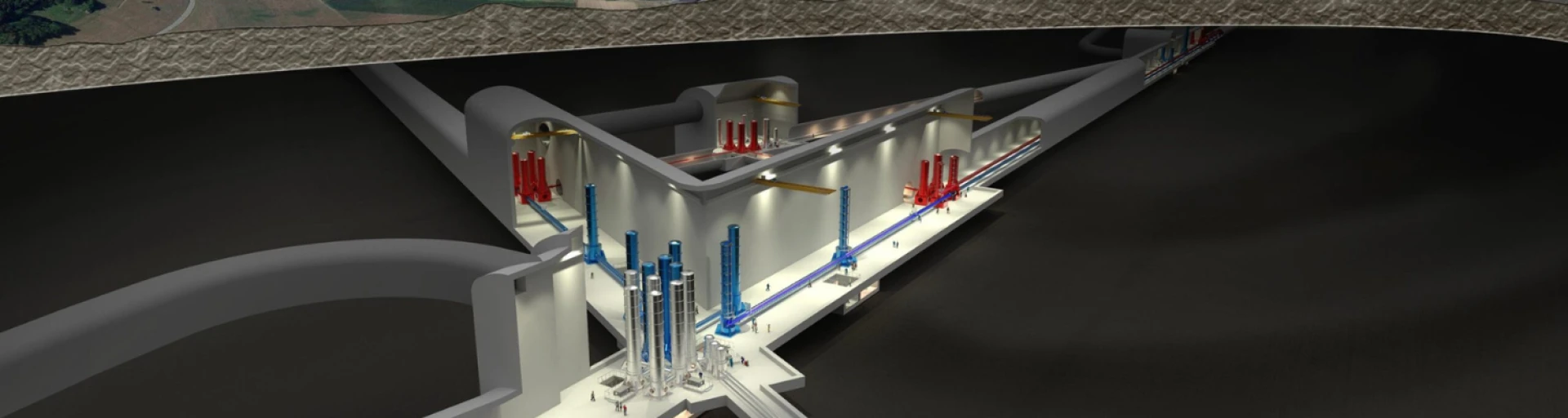
Gravitational waves are minute ripples in space and time, caused by extreme events such as the merger of black holes. The Einstein Telescope is designed to measure these waves much more accurately than is currently possible, enabling scientists to peer deeper into the universe. The detector will be located hundreds of meters underground, with three tunnels, each ten kilometers long.
Extreme demands on precision
The Einstein Telescope requires cutting-edge precision technology. The design comprises three tunnels, each ten kilometres long, and shafts three hundred metres deep, and the measuring instruments must operate completely vibration-free. JPE is therefore developing a vibration isolator that operates in a vacuum at minus 263 degrees Celsius, the environment in which the telescope’s mirrors are located. Demcon Kryoz and the start-up Cooll, both spin-offs from the University of Twente, are building a cooler with no mechanically moving parts. The work is supported, amongst others, by the National Growth Fund and Interreg projects. The companies also see applications outside the project, such as in quantum computing and the semiconductor industry.
The Precision Fair as a meeting place
This year, the Precision Fair is celebrating its 25th anniversary. Nikhef, the National Institute for Subatomic Physics and one of the driving forces behind the Netherlands’ ET ambitions, first presented the European plans at the fair ten years ago. The project will also feature prominently at this anniversary edition. On 18 November, Albert van Dorssen, Business Developer for the Einstein Telescope’s Commercialisation Programme, will outline the opportunities that will arise in 2027 and 2028, now that the focus is shifting towards industrialisation. The trade fair is organised by Mikrocentrum, the independent foundation that has been connecting knowledge in the high-tech and manufacturing industries for over 55 years.