

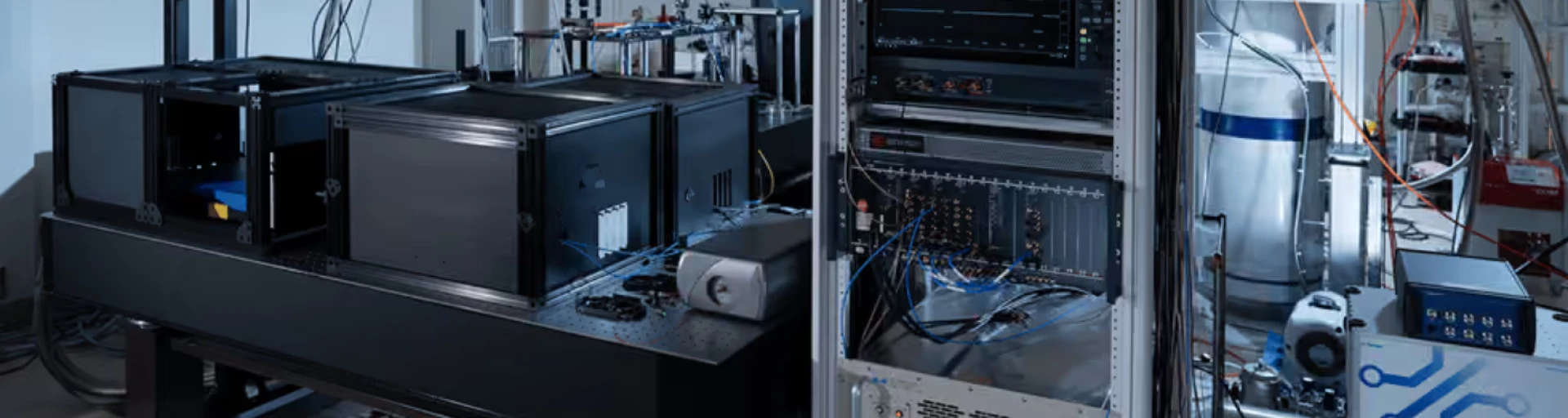
Quantum computers operate in a fundamentally different way to the computers we know today, which means that in the future they will be able to solve problems that are beyond the capabilities of conventional computers. Most quantum computers currently in use rely on superconducting chips, which need to be kept extremely cold in order to function.
The new prototype developed by TU Delft and Fujitsu operates using the so-called ‘diamond spin’ approach: information is stored in tiny imperfections within the crystal lattice of diamond, also known as colour centres. For this prototype, Fujitsu utilised tin vacancy centres (SnV centres), a variant that is less sensitive to external noise than the more commonly used nitrogen vacancy centres (NV centres), and therefore produces more stable and brighter qubits. This makes the system easier to scale up and integrate with other quantum modules, which is crucial for eventually achieving truly large, usable quantum computers.
The research is the result of a collaboration between Fujitsu, Delft University of Technology and the QuTech research institute, which has been ongoing since 2020.
"We are delighted to announce this prototype diamond-spin quantum computer, which is the result of joint research carried out since 2020 by Fujitsu, Delft University of Technology and QuTech. It marks a significant milestone in our close collaboration."
Dr Kees Eijkel, Managing Director of QuTech
Three technological breakthroughs
In order to build this prototype, Fujitsu had to overcome a number of technical hurdles:
- For instance, the company developed a method for producing extremely thin layers of diamond and bonding them to other chip materials, so that the diamond is suitable for use in a computer chip.
- In addition, a technique was developed to accurately capture and read the light emitted by the diamond particles, which is essential for reading the calculation results.
- Finally, a method has been found to translate the desired calculations into concrete control signals using light and waves, enabling the system to be controlled from Fujitsu’s platform.
Together, these three innovations ensure that the technology not only works in the laboratory, but also becomes practically applicable. Furthermore, the prototype operates at -271.6 °C, which is slightly warmer than the temperature at which superconducting quantum computers typically operate (-273.13 °C) – a small difference with major practical implications for future applications.
"The diamond spider approach we have applied in this prototype not only offers exceptional scalability in its own right, but can also be integrated with superconducting quantum computers. This will further expand their capabilities, enabling more complex and large-scale computations."
Vivek Mahajan, Corporate Executive Officer, Corporate Vice President and CTO, Fujitsu Limited
The contribution of Holland High Tech
The fact that this breakthrough is possible is also linked to public-private funding from the Netherlands. In 2018, Holland High Tech signed an agreement with QuTech and recognised, even then, the strategic importance of quantum technology for the Dutch high-tech sector. Since then, Holland High Tech has funded QuTech through public-private partnership (PPP) funds, including this research project with Fujitsu.
"Breakthroughs like this demonstrate exactly why we have been investing in quantum technology for years. By providing long-term support for research at an early stage in the process, we are ensuring that the Netherlands continues to play a leading role in the global development of this technology."
Leo Warmerdam, Managing Director of Holland High Tech