

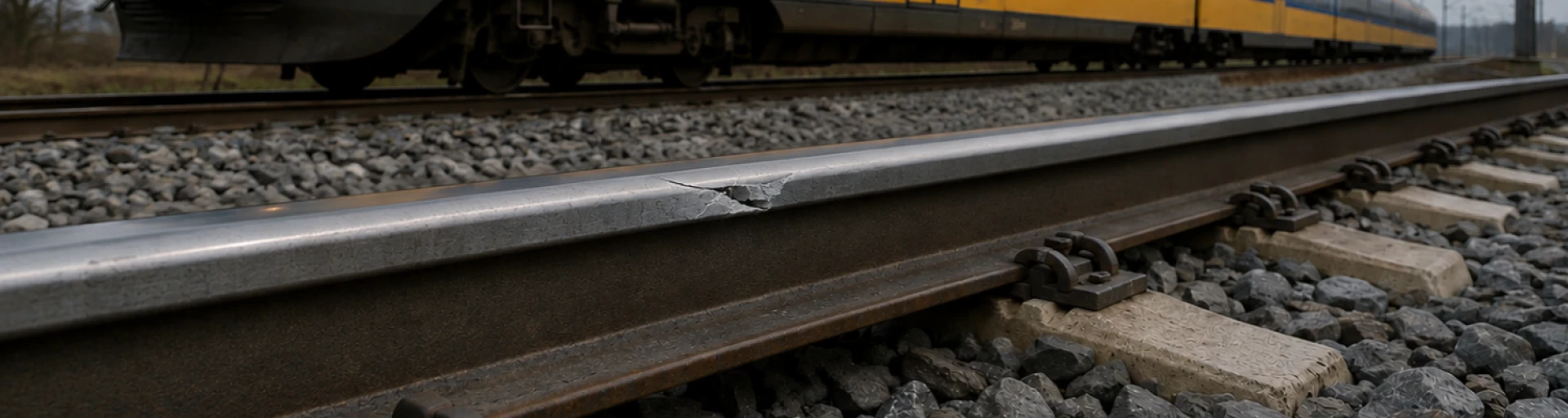
Fatigue and structural reliability of defective rails containing squats
The proposed research will develop the first probabilistic fatigue crack growth framework squat defects. The model will combine fracture mechanics, structural reliability methods, and Bayesian updating to predict crack growth. Uncertainties associated with material properties, fracture resistance, operational loading, crack-driving forces, and inspection measurements will be explicitly quantified and incorporated into the analysis. In particular, the research will address the uncertainty associated with ultrasonic inspection data, since measured crack sizes do not directly represent the true defect dimensions.
A dedicated field monitoring campaign will provide repeated observations of squat defects under operational railway conditions. These measurements will be used to calibrate and validate the probabilistic model. The industrial goal is to support ProRail in the transition towards data-driven and risk-informed asset management. The developed methodology will enable the determination of line-specific inspection intervals and maintenance actions based on quantified probabilities of failure rather than empirical rules. Ultimately, the project will contribute to safer railway operations, reduced life-cycle costs, fewer unplanned interventions, and more efficient use of maintenance resources.