

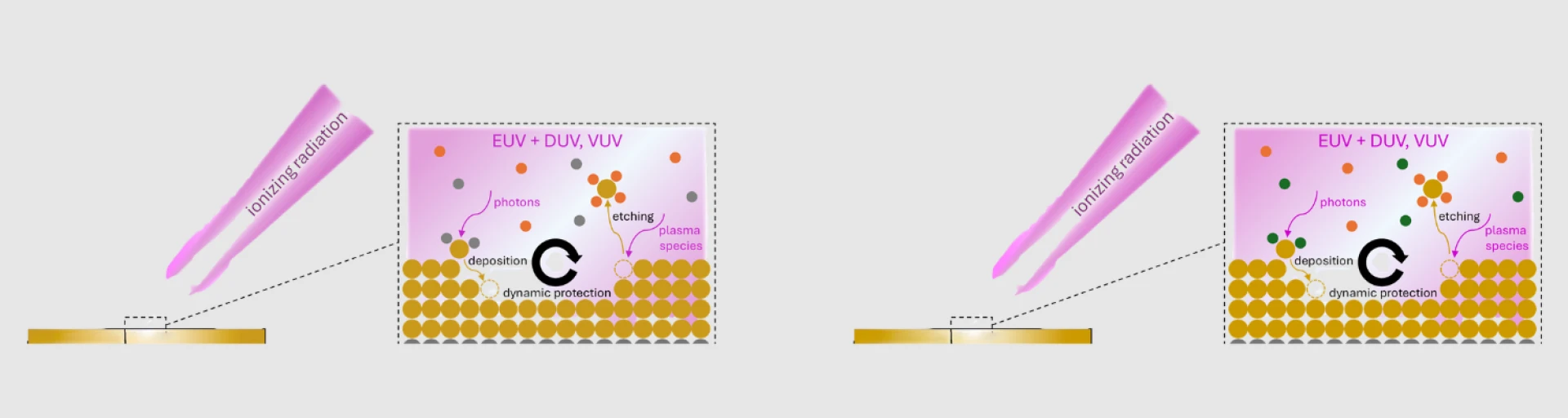
Dynamic protection of surfaces exposed to plasma and ionizing radiation
Quantification of VUV and DUV emission by EUV plasma
TNO and ASML are working together on this joint project to improve the durability and performance of semiconductor manufacturing equipment that uses extreme ultraviolet EUV technology. EUV radiation and low-pressure purge gas interact to form an EUV-induced plasma. This plasma emits radiation across multiple wavelengths. The amount of radiation steadily increases with continuously increasing source power of lithography tools. It is however not known how much radiation is produced, what fraction is ionizing and how this radiation impacts the surface physics and chemistry of EUV-exposed surfaces. In the first part of the project, we will review theoretical models and experimental data to estimate the intensity of plasma-emitted radiation.
Impact of VUV and DUV emission on surface chemistry and physics
The proposal focuses on understanding the role of deep UV and vacuum UV emission by EUV plasma on the performance of critical surfaces during EUV irradiation. We will adapt existing surface reactions models for EUV radiation to the relevant DUV and VUV wavelengths. Secondly, we will evaluate the magnitude of VUV and DUV induced effects and compare those to the effects from the primary EUV beam. This study shall include the impact of the photons and the impact of the secondary electrons emitted during irradiation (photo-electric effect). The insights gained from this study will aim to extend equipment lifetime, improve productivity, and reduce contamination risks, ultimately lowering maintenance costs and minimizing environmental impact.
Dynamic surface protection for EUV irradiated surfaces
The combination of strongly ionizing radiation (EUV, VUV, DUV) and trace amounts of water poses a continuous risk for oxidation of surfaces, which reduces their lifetime over time. The core idea here is to passivate such critical surfaces dynamically. This means that the protective layer is continuously eroded by interactions with EUV and plasma, but this erosion is compensated by regrowth of the layer (continuously, or during regeneration cycles). This should provide a dynamic barrier layer that passivates surface sites on the surface for reactions with water and metallic contaminants. Specifically, we will identify promising materials for the dynamic protective layer, and clarify how they are applied in-situ.