
TNO Space and Qubitrium are launching EPIQ on Lizziesat (October 2026) as a first step
Objective: to test whether quantum hardware can withstand space conditions
Focus on miniaturisation: towards a scalable, European quantum satellite network
New opportunities for supply chain partners
Qubitcore-in-Space: the first step towards a European quantum internet via satellite
16 June 2026
Quantum technology offers new opportunities to secure data traffic extremely effectively through the development of a quantum internet. Within a few years, these secure connections will be essential for both civilian and military applications. For long-distance communication, quantum connections via satellites will play a key role. China already has a significant lead in this field of research. TNO Space and Quantum Key Distribution (QKD) specialist Qubitrium are taking the first step towards closing the gap with the launch in October (2026) of the EPIQ payload in the Lizziesat. TNO is programme manager for Holland High Tech’s strategic Space programme.
The Qubitcore-in-Space project receives support from Holland High Tech under the Public-Private Partnership Innovation Scheme (PPS-I) of the Ministry of Economic Affairs and Climate Policy. This article is the second in a series of articles on the impact of innovation through PPS-I projects.
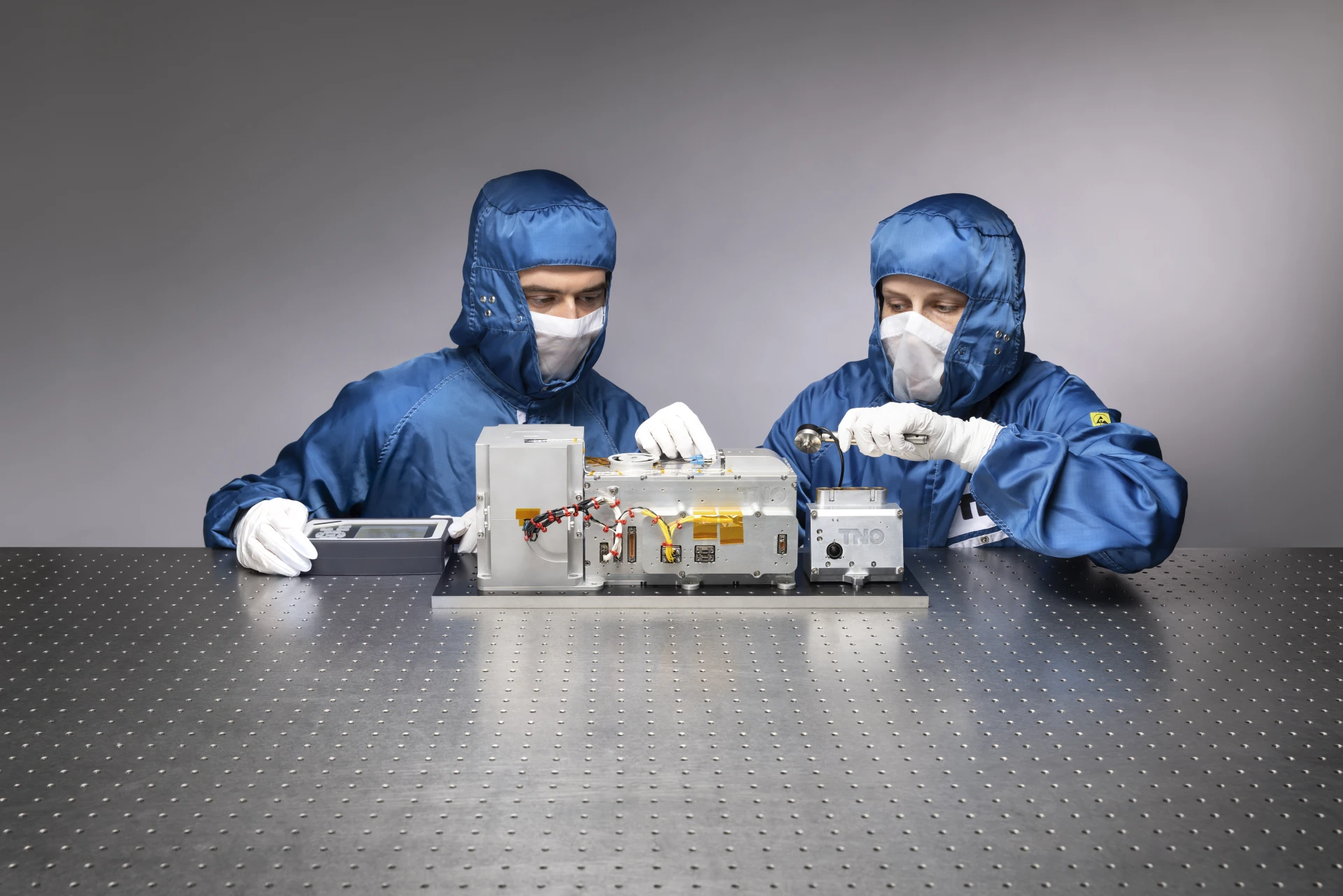
* Source photo: TNO
Although the Lizziesat is not literally being sent to the moon, this is truly a moonshot project, according to Kees Buijsrogge, Director of Space & Scientific Instrumentation at TNO. The Qubitcore-in-Space project is not a clearly defined project with a quick end application, but a link in the development of a comprehensive long-term vision. “At TNO Space, we have a moonshot and a roadmap for every topic we’re working on. A moonshot revolves around a vision of what we believe the world will need in ten to fifteen years’ time. With the roadmap, we look at the steps we need to take to get there. For quantum communication, the moonshot is a global quantum internet, which requires satellites.”
“For quantum communication, the moonshot is a global quantum internet, which requires satellites.”
Kees Buijsrogge, Director of Space & Scientific Instrumentation, TNO
The Qubitcore-in-Space project is one of the first steps in that roadmap. Its main aim is to investigate how well the infrastructure required for a quantum-secure connection can withstand the conditions in space. Much of this equipment has been developed by Qubitrium. This company is a spin-off from Turkey’s Özyeğin University (OzU) and specialises in terrestrial QKD connections. The company has focused on miniaturising the components required for this. That specialism offers an immediate opportunity to catch up with China’s lead in quantum satellite communication, says Kadir Durak, CEO of Qubitrium. “Due to the size of the equipment, the Chinese approach is not particularly suitable for commercial applications. With the miniaturisation we have already achieved, you can equip thousands of satellites, such as a Starlink network, with quantum communication.”
Important for European autonomy
Buijsrogge believes it is vital that Europe commits fully to this development, as Europe must not become dependent on China, nor on the US. He highlights initiatives for the development of IRIS2 (IRIS squared), a European alternative to Starlink consisting of 18 satellites at an altitude of approximately 8,000 km (MEO) and 260 satellites at an altitude of 1,200 km (LEO). The European Commission has already stated that no American components may be included in that network. “Let alone that American components may be incorporated into a quantum-secure network.”
TNO has been working for some time on a compact source of quantum-entangled photons suitable for use in satellites. However, there was no prospect of testing it in space in the foreseeable future, explains Nienke ten Haaf, a scientist in TNO’s Quantum Technology department. By chance, she and her team were able to make rapid progress on this development. In a planned project for the launch of a research satellite – the Lizziesat – previously reserved space was no longer needed. This created an opportunity to include a quantum payload, called EPIQ, on the satellite.
This project also required photon detectors suitable for use in space. Qubitrium had experience in this area. In the end, there was even some space left over, so Qubitrium’s miniature QKD system could also be included in this Lizziesat. “This was a truly fantastic opportunity, but at the same time a huge challenge,” says Ten Haaf. “It was only in April last year that contact was established between TNO and Qubitrium. The project also fitted well within the Holland High Tech Space strategic programme, in which TNO acts as programme leader, so we were able to get started. In the end, we only had a year to get the payload ready for launch. That’s really not a typical timeline for a space project. But we made it!”
“This was a truly fantastic opportunity, but at the same time a huge challenge.”
Nienke ten Haaf, Scientist Quantum Technology, TNO
Space research requires patience
The launch of the Lizziesat is now scheduled for October this year. “For us, it is particularly important to demonstrate that the equipment works in space and to identify the optimal wavelength range,” explains Alper Özülker. He works as R&D Team Lead at Qubitrium’s Dutch branch. “Secondly, we want to investigate how conditions in space affect the performance of the systems.” This includes, among other things, the effects of temperature fluctuations and the influence of charged particles in space that cause material degradation.
“For us, it is particularly important to demonstrate that the equipment works in space.”
Alper Özülker, R&D Team Lead, Qubitrium
The system on board the Lizziesat is therefore not designed to establish fully quantum-secure communication between the ground station and the satellite. Much of the measurement and detection work is carried out using sensors on board the spacecraft. The data is transmitted to Earth via standard channels. “Our main aim is to gain experience in space that will make it easier later on to organise missions capable of establishing genuine connections between the ground stations and the satellites,” explains Özülker.
The Lizziesat is expected to remain operational for three to five years. However, this does not mean that the research team will be able to start taking measurements immediately after launch. The operator needs the first few weeks to activate and test all the satellite’s basic systems. Only then will the payload functions be activated step by step according to a tight schedule. So, over the coming months, the team will have to wait patiently for the first results to trickle in. In the meantime, research in the labs on Earth continues as usual, potentially yielding new insights that the researchers would also have liked to test in space. It will soon be two years between the time the research and tests on Earth must be completed for a mission, and the time results come in from space, confirms Buijsrogge. “That’s awful, absolutely dreadful. But that’s the case with every space research project.”
Using CubeSats keeps costs down
In the meantime, the team is already working on preparations for future missions. Özülker: “We work iteratively. In fact, an initial version of what we are now going to test was launched into space a month ago. We have already demonstrated the operation of the QKD chip in space with that. The bigger picture is that if we see that everything works with the application, we will eventually be able to build a constellation with more satellites.”
It is better not to take all the risky steps at once, Durak and Buijsrogge add. In this type of research, a rapid, iterative approach is adopted. By using small, relatively inexpensive satellites, known as CubeSats, technologies can be validated more easily one by one. “Traditional space research involves building satellites that can cost hundreds of millions. With this approach, we keep costs low and can secure funding more easily,” explains Buijsrogge.
The impact of the research is significant
Research into highly secure communication using quantum communication is still in its early stages. However, TNO and Qubitrium expect the results to ultimately have a major societal impact, for both military and civilian applications. Durak: “The defence industry is less interested in QKD itself, but is interested, for example, in robust time synchronisation.” Military personnel in the field are currently heavily reliant on satellite-based systems such as GPS and Starlink for positioning and navigation. These networks are controlled by American companies and are easily jammed or even shut down, as the Ukrainian army has experienced in the war against Russia. If Europe were to have its own satellite network with quantum-secure communication, this kind of essential information provision could be better stabilised.
There is, in fact, considerable interest in QKD-secured communications from the financial sector and government. “At this stage of the research, it is not yet necessary to distinguish between the requirements of different end-users. The priority now is to gain experience with the equipment in space,” explains Ten Haaf.
“The defence industry is interested in robust time synchronisation.”
Kadir Durak, CEO, Qubitrium
Once these first steps towards the quantum internet have been successfully taken, a wealth of opportunities will arise for businesses within a new European supply chain. Buijsrogge: “What I like – and I’m glad Qubitrium feels the same way – is that with Qubitcore-in-Space we’re helping to create the umbrella. That way, we as companies can work together to achieve something like this, rather than just having one-off projects. I certainly don’t want to sound arrogant, but we are organising these collaborations or at least helping to organise this development.”
Previous articles in the series: