

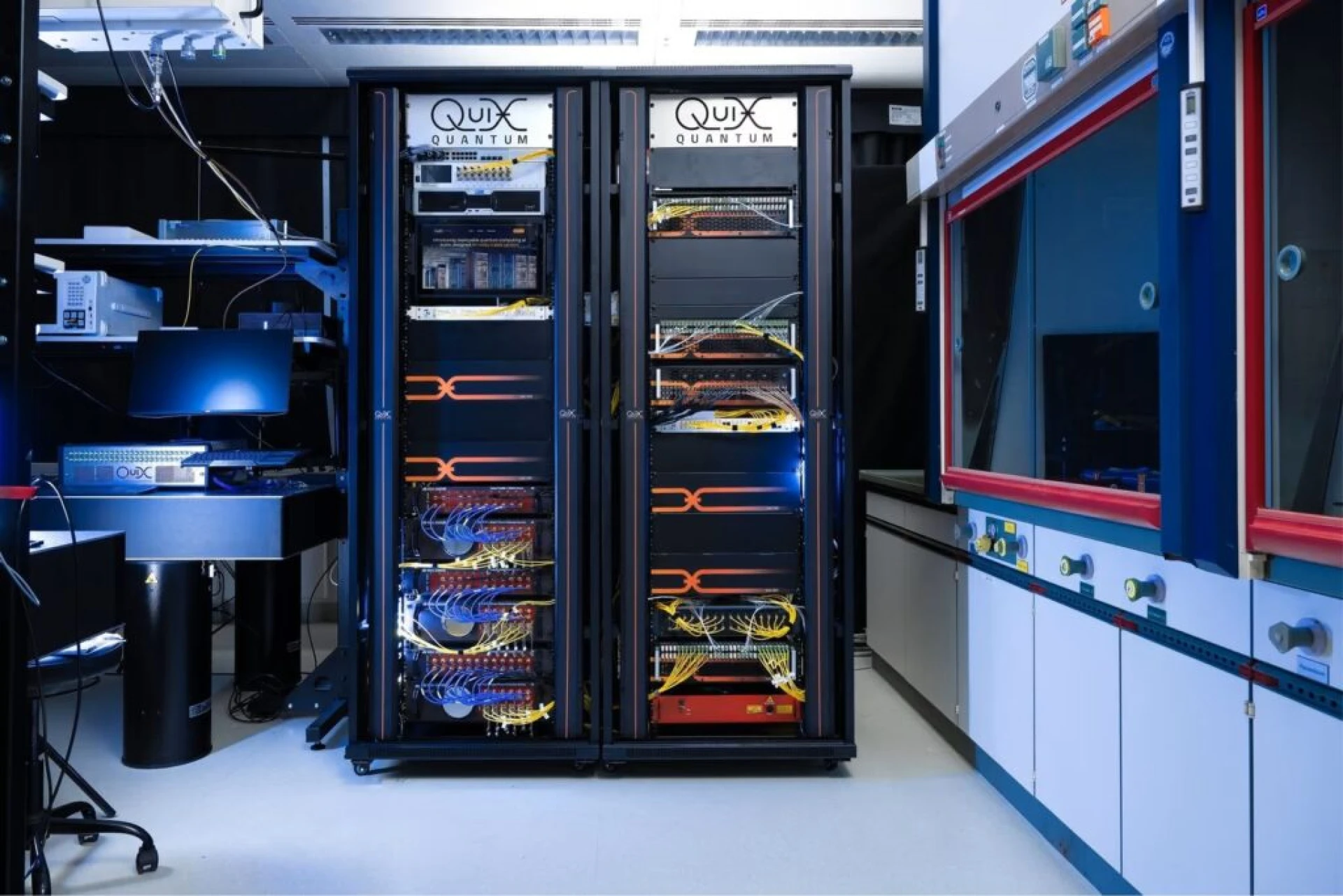
Previous photonic systems were often only capable of handling one type of computational task. Carina is designed in such a way that, in theory, it can perform any quantum computation. That is a key difference: the question is no longer whether this type of technology can be widely applied, but how quickly that will happen.Carina was developed as part of DLR’s Quantum Computing Initiative and is funded by the German government. Carina’s hardware has now been delivered to DLR.
Works with light, not with extreme cold
What makes QuiX’s technology unique is that individual light particles (photons) are used as the unit of computation, rather than the superconducting chips required by many other quantum computers. As a result, most of Carina can operate at room temperature. This eliminates the need for a great deal of expensive and energy-intensive cooling. To achieve this, Carina combines various techniques: the generation and measurement of light particles, the control of the optical components, and lightning-fast feedback between those components. All these building blocks are integrated into a single system that fits into a standard server rack.
A step towards an even more reliable system
QuiX Quantum sees Carina as the basis for the next, even more advanced version, which the company calls Dedalo. The aim is for the technology not only to become universal, but also to be far less prone to errors, which is necessary to make quantum computers usable on a large scale.
Stefan Hengesbach, Director of QuiX Quantum, says that until now the sector has consisted of two camps: systems that could be brought to market quickly but were not universally applicable, and systems with great future potential that were difficult to install in practice. According to him, Carina brings these two worlds together for the first time. Professor Gerard Milburn of the University of Queensland, one of the scientists who pioneered this form of quantum computing, describes the launch as a milestone the field has long awaited.