

Wavelength-multiplexing for high-throughput ultraclean wafer dicing
Within the project the industrial partner inPhocal B.V. and the Chair of Laser Processing at the University of Twente (UT) develop the proof of concept of subsurface laser dicing of silicon wafers required for the next generation of electronic chip technology, namely heterogeneous integration.
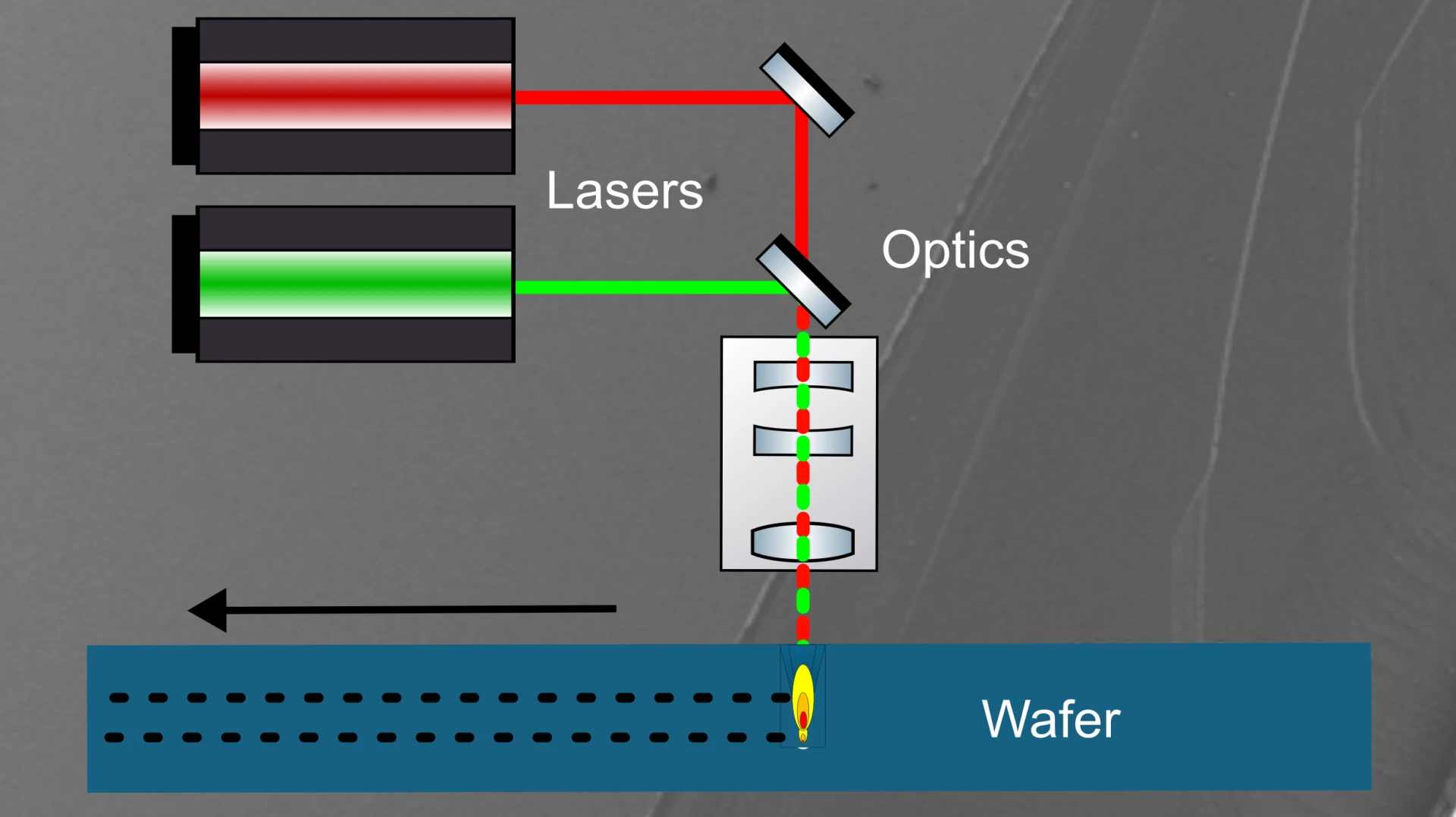
In the project, we will scale an existing proof-of-principle demonstrating the nanosecond-pulsed laser dicing of a silicon wafer with low sidewall roughness and narrow laser focus, to be used in the targeted industrial application. A model will be developed, and verified experimentally with the wavelength-multiplexing, upscaling technique developed at the University of Twente, using optics hardware developed at inPhocal.
The project is expected to start a long-term strategic relationship combining the optics and process expertise of the two partners. The research and collaboration are thought to be a key enabler for complex next generation electronic chip devices and has the potential to be extended to other micro-opto-electro-mechanical system (MOEMS) technologies.