

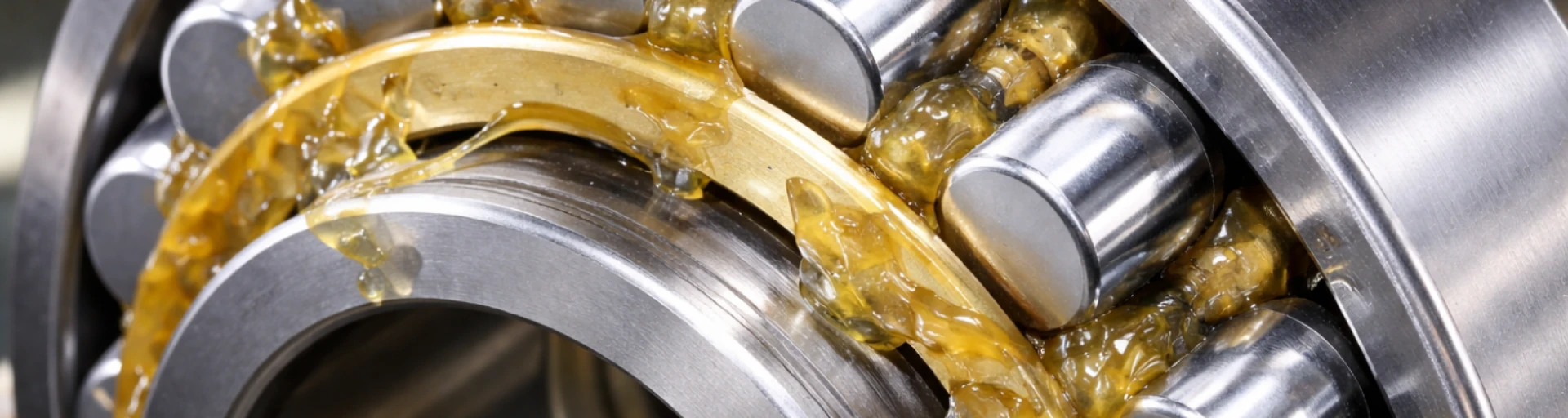
Film thickness for grease lubricated cylindrical roller bearings
Previous work within the University of Twente–SKF collaboration has led to the development of a theoretical model describing the decay of lubricant film thickness during operation. This model is based on grease oil content measurements obtained in earlier studies. In parallel, a dedicated measurement technique has been developed to determine film thickness in grease-lubricated cylindrical roller bearings. These studies have resulted in an empirical description of the initial film thickness, which forms an essential input for the film thickness decay model. However, several aspects of the current modelling framework remain speculative and require experimental validation.
This replenishment of the contact by grease bleed from underneath the cage needs to be investigated. This depends on the amount of grease that can be transported under the cage and on the ability of the grease to release base oil. Both properties change during bearing operation due to shear ageing of the grease. In addition, side-flow mechanisms causing loss of base oil from the contact region need to be studied to confirm the assumptions used in the model. The objective of this project is to validate the assumptions underlying the existing film thickness decay model and to establish a reliable relation between lubrication conditions, grease behaviour and composition, and the evolution of film thickness in cylindrical roller bearings.